How to Read Football Prediction Percentages Correctly
Learn how to read football prediction percentages correctly, understand win probabilities, avoid common mistakes, and use prediction data in a smarter way....
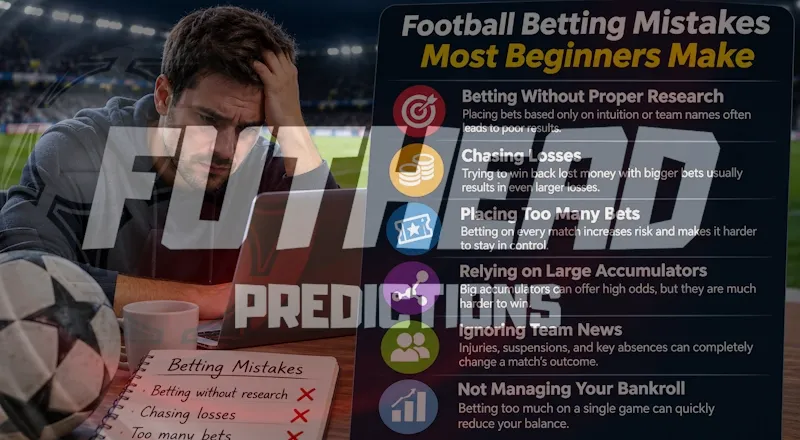
Football betting can look simple when you first start. You choose a match, pick the team you think will win, and hope for the best. But there is much more to it than that. Many beginners make the same mistakes because they focus on possible winnings instead of understanding the risks, the odds, and the information behind each match.
Even people who follow football every week can make poor betting decisions. Knowing the best players and supporting a successful club does not automatically make someone good at predicting results. Understanding the most common football betting mistakes can help beginners make more informed decisions, avoid unnecessary risks, and develop a more disciplined approach.
One of the biggest football betting mistakes is allowing emotions to influence decisions. Many beginners bet on their favourite club because they believe it will win, even when the available information suggests the match could be difficult.
Supporting a team can make it harder to judge performances honestly. You may ignore poor form, defensive problems, injuries, or the strength of the opponent. The same problem happens when someone bets against a rival club simply because they want that team to lose.
Football predictions should be based on information rather than personal feelings. Before choosing a result, compare both teams objectively. Look at their recent performances, home and away records, injuries, and tactical strengths. If you cannot analyse a match without bias, it may be better to avoid betting on it.
Another common beginner mistake is relying too much on the league table or the reputation of a club. A team may be near the top of the standings but struggling in recent matches. Another team may be lower in the table but improving every week.
Recent form helps you understand what is happening now. Check the last five or ten matches, goals scored, goals conceded, clean sheets, and the quality of opponents. A team that has won several games against weak opposition may not be as strong as its results suggest.
It is also important to separate home and away form. Some clubs perform very well in their own stadium but struggle when travelling. Ignoring these differences can lead to poor predictions, especially when two teams have similar overall records.
High odds can be attractive because they offer a larger potential payout. This is why many beginners choose unlikely results, correct scores, or underdog victories without considering how difficult those outcomes are to predict.
For example, decimal odds of 5.00 offer a much bigger return than odds of 1.50, but they also represent a lower implied probability. A bigger possible payout does not mean the selection is better.
The opposite mistake is assuming that very low odds are guaranteed to win. Even strong favourites can draw or lose. Beginners should learn to compare the probability of an outcome with the odds being offered rather than choosing selections based only on the potential return.
Accumulators are popular because combining several selections can create attractive total odds. A beginner may choose five, eight, or even ten favourites and believe the bet has a good chance because every team looks strong individually.
The problem is that every extra selection creates another opportunity for the entire bet to lose. Even if each selection has a relatively high probability of winning, the probability of all selections winning together becomes much smaller.
For example, if five independent selections each have an 80 percent chance of winning, the probability of all five winning is approximately 33 percent. That is much lower than many beginners expect.
Understanding this difference is important. An accumulator can look attractive on paper while carrying considerably more risk than a single selection.
Chasing losses is one of the most dangerous mistakes in football betting. It happens when someone loses a bet and immediately places another one, often with a larger stake, in an attempt to recover the money.
This behaviour can quickly lead to even bigger losses. A bad result does not make the next prediction more likely to win. Every match has its own circumstances, and losing money earlier does not improve the probability of success later.
Emotions can also affect judgment after a loss. Frustration may cause someone to ignore statistics, choose unfamiliar leagues, or place bets they would normally avoid.
The better approach is to accept that losses are part of betting. Never increase stakes simply to recover money, and stop betting when emotions begin to influence decisions.
Many beginners start betting without deciding how much money they can afford to lose. They may place small bets at first but gradually increase the amount when they feel confident or want to recover previous losses.
Setting a fixed betting budget is an important way to control financial risk. This money should always be separate from funds needed for rent, food, bills, savings, or other essential expenses.
It is also important to understand that no staking strategy can guarantee a profit. Even careful analysis can produce losing predictions, and a long sequence of bad results is always possible.
Beginners should establish limits before placing any bets and avoid changing those limits because of a winning or losing streak. If gambling stops being enjoyable or begins causing financial pressure, taking a break or seeking support is the right decision.
Sometimes beginners choose matches simply because they are available. They may see a football game starting soon and decide to bet without knowing much about either team.
This is especially common with unfamiliar leagues, reserve competitions, and matches where reliable team news or statistics are difficult to find. Without enough information, predictions become little more than guesses.
Before considering a match, check recent results, goals scored, defensive records, injuries, suspensions, and expected lineups. It is also useful to know whether the match is important for the league standings or whether either team may rotate players.
If reliable information is missing, there is no reason to force a prediction. Sometimes avoiding a match is the most sensible decision.
Football prediction websites often display percentages for home wins, draws, away wins, over and under goals, and both teams to score. These numbers can be useful, but they should never be treated as guarantees.
A prediction showing a 75 percent chance of winning still means there is a 25 percent chance that the selection will fail, assuming the estimate is accurate. In football, that is a meaningful level of risk.
Another important detail is that different prediction models may use different data and methods. Some rely heavily on recent results, while others consider expected goals, team ratings, or betting market information. Their percentages may not always be well calibrated.
Beginners should use prediction percentages as one part of their research, not as automatic instructions to place bets.
Team news can change the expected outcome of a football match. A strong team may suddenly become less dangerous if its main striker is unavailable. A missing goalkeeper or central defender can also create defensive problems.
Some beginners make predictions several days before a match and never check whether the situation has changed. However, injuries, suspensions, fatigue, and squad rotation can all affect the original analysis.
Whenever possible, check reliable injury reports and confirmed starting lineups before kick-off. Pay attention not only to how many players are missing, but also to their importance and the quality of the available replacements.
Many beginners feel they need to bet every day or on every big football match. This can lead to rushed decisions, poor research, and unnecessary risks.
Some matches are simply too unpredictable. The teams may have similar strengths, unclear motivation, important injuries, or inconsistent recent performances. In other situations, the odds may not offer good value even when one result seems more likely.
There is nothing wrong with watching football without placing a bet. Being selective and knowing when to stop are important parts of keeping betting under control.
A better approach begins with patience and preparation. Learn how the main betting markets work, understand basic probabilities, and study matches before making decisions. Keep track of your predictions so you can review the reasoning behind them rather than judging everything by one result.
It is also useful to compare the odds available with your own assessment of the match. A likely winner is not automatically a good betting opportunity, especially when the price is very low. Remember that bookmaker margins make consistent profitability difficult, even for knowledgeable football fans.
Most importantly, keep gambling separate from financial goals. Betting should never be treated as a reliable way to earn income, and no football prediction method can eliminate the possibility of losing money.
The most common football betting mistakes beginners make include following emotions, ignoring team form, chasing high odds, building large accumulators, failing to manage a budget, and trusting predictions too much. These mistakes often happen because beginners focus on winning instead of understanding how much uncertainty exists in every match.
Learning about football statistics, odds, team news, and different betting markets can help you make better-informed choices. However, knowledge does not remove risk, and even excellent analysis can lead to incorrect predictions.
The most important lesson is simple: be patient, think carefully, respect your limits, and never chase losses. Understanding these mistakes is a useful first step towards a more responsible approach to football betting.