Why Football Predictions Are Never Guaranteed
Learn why football predictions are never guaranteed, even with strong data, team form, statistics, odds, and expert analysis....
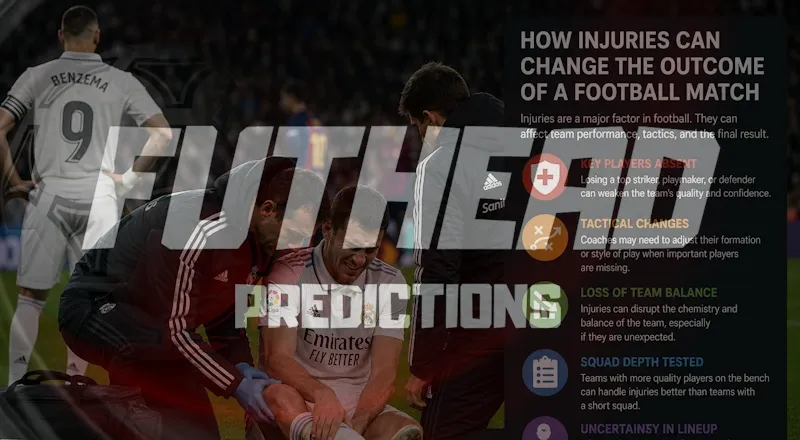
Injuries are one of the most important factors to consider when making football predictions. A team can look strong on paper, have good recent form, and play at home, but if important players are missing, the match can become very different. One injury can change the balance of a team, especially when it affects a key position such as goalkeeper, central defender, midfielder, or striker.
Many people focus only on league position, recent results, or head-to-head records. Those things are useful, but they do not always show the full picture. Football is played by players, not just by statistics. When the right players are unavailable, the quality, confidence, and tactical plan of a team can change quickly.
Injuries matter because football teams depend on structure and balance. Every player has a role. Some players score goals, some create chances, some protect the defence, and others control the rhythm of the game. When one important player is missing, the whole team may need to adjust.
A team may still have strong replacement options, but not every substitute can offer the same quality. A backup player may be less experienced, less confident, or less suited to the style of the match. This is why injuries can influence predictions even when the rest of the team looks strong.
For example, if a team loses its main striker, it may still create chances but struggle to finish them. If it loses a defensive midfielder, the back line may become more exposed. If it loses a centre-back, set pieces and aerial duels may become a bigger problem. These details can change the outcome of a match.
Not every injury has the same importance. Missing a squad player is very different from missing a star player or a key tactical piece. The biggest impact usually comes when a team loses a player who is central to how it plays.
A creative midfielder can be vital because they connect defence and attack. Without that player, a team may struggle to create clear chances. A fast winger can stretch the opponent and create space. Without that pace, the attack may become predictable. A strong centre-back can organise the defence. Without that leadership, the team may look nervous and make more mistakes.
This is why it is important to ask which player is injured, not just how many players are injured. A team missing three rotation players may cope well. A team missing one world-class goalkeeper or one main goal scorer may suffer much more.
Goalkeeper injuries can have a huge effect on a football match. The goalkeeper is the last line of defence and often controls the confidence of the defenders in front of them. If a team has to use a backup goalkeeper, the defence may become less calm, especially under pressure.
A good goalkeeper does more than save shots. They organise the back line, deal with crosses, start attacks with passing, and make important decisions in difficult moments. If the replacement goalkeeper is less experienced, the opponent may try more long shots, crosses, or set-piece deliveries.
For predictions, a goalkeeper injury can affect several markets. It may make clean sheet predictions weaker, increase the chance of goals, or reduce confidence in the team to win. Even if the team is strong in attack, defensive uncertainty can change the match.
Defensive injuries are very important because they can affect the stability of the whole team. If a team loses one or two defenders, the coach may need to change the back line, use players out of position, or adjust the formation.
This can create problems with communication, marking, and positioning. Defenders need to understand each other well. They must know when to press, when to hold the line, and how to cover space. If the defensive unit is changed suddenly, mistakes can happen more easily.
Defensive injuries are especially important against teams with strong attackers. A weakened defence may struggle with pace, movement, crosses, or set pieces. This can make both teams to score or over goals predictions more interesting, depending on the full match context.
Midfield injuries are sometimes underrated, but they can be decisive. The midfield controls the tempo of the game. It helps the defence, supports the attack, wins second balls, and decides whether a team can keep possession.
If a team loses an important defensive midfielder, it may become easier for the opponent to attack through the centre. If it loses a creative midfielder, it may struggle to break down a compact defence. If it loses a box-to-box player, it may lack energy and pressing.
When analysing injuries, always look at the midfield balance. A team can have good forwards, but if the midfield cannot supply them properly, the attack may look isolated. This can reduce the chance of goals and make the team less reliable in match predictions.
When a team loses its main striker or most dangerous winger, its goal threat can drop. This is one of the most obvious ways injuries can change a football match. A team may still play well, but without a natural finisher, it may fail to turn chances into goals.
Attacking injuries can also change how opponents defend. If the main goal scorer is missing, the opponent may feel more comfortable pushing higher up the pitch. If a fast winger is unavailable, the opponent may not be as worried about space behind the defence.
For predictions, attacking injuries are very important for markets connected to goals. They can affect match winner predictions, over and under goals, team goals, and both teams to score. A team that normally scores often may become less dangerous if its best attacking players are missing.
Injuries do not only remove players. They can also force tactical changes. A coach may change formation, use a more defensive setup, or ask players to perform different roles. This can make the team less fluent than usual.
For example, if a team loses both full-backs, it may stop attacking wide areas as much. If it loses a defensive midfielder, it may play with a deeper block to protect the defence. If it loses a striker, it may use a false nine or rely more on crosses and long shots.
These changes can affect the whole prediction. A team that normally plays attacking football may become more cautious. A team that usually controls possession may become more direct. This is why injuries must be connected to tactics, not only counted as names on a list.
The effect of injuries depends heavily on squad depth. Big clubs often have strong replacements, while smaller clubs may struggle when important players are unavailable. This does not mean big clubs are never affected, but they are usually better prepared to deal with absences.
A team with a deep squad can rotate players and keep a similar level of quality. A team with a thin squad may need to use inexperienced players or change its style completely. This difference is important when making football predictions.
Before reacting to an injury, check who can replace the missing player. If the replacement is strong and fits the system, the impact may be smaller. If the replacement is weak or out of position, the injury may be much more serious.
Late injury news can change predictions very quickly. Sometimes a player is expected to start but is left out of the squad shortly before kick-off. This can happen because of a warm-up problem, illness, fatigue, or a late fitness test.
This is why it is useful to check confirmed lineups when possible. A prediction made early in the week may look good at the time, but it can become weaker if team news changes. The closer you get to kick-off, the more important accurate information becomes.
Late injuries can also affect betting odds and prediction percentages. If a key player is suddenly ruled out, the market may move quickly. For better football predictions, it is important to stay updated and avoid relying only on old information.
The best way to use injury news is to focus on quality, position, and tactical importance. Do not simply count the number of injured players. Ask how important each player is, what role they play, and whether the team has a good replacement.
You should also compare injuries on both sides. If both teams are missing defenders, the match may become more open. If one team is missing attackers and the other has a strong defence, goals may be harder to find. If one team has several midfield absences, it may struggle to control the game.
Injury news should always be combined with other factors such as form, motivation, home advantage, away form, schedule pressure, and opponent quality. Injuries are powerful, but they are only one part of the full prediction process.
Injuries can change the outcome of a football match because they affect quality, tactics, confidence, and balance. Missing one important player can be enough to weaken a team, especially if that player is central to the way the team attacks, defends, or controls the midfield.
For better football predictions, you should always check injuries before making a decision. Focus on key players, important positions, squad depth, confirmed lineups, and the tactical impact of each absence. A strong team can still win with injuries, but the risk may be higher than it first appears.
The smartest approach is to treat injury news as a major part of match analysis. When you understand how injuries change a team, your predictions become more realistic, more careful, and much better prepared for what may happen on the pitch.